

American War Chapter 1 Summary
Southouth of downtown Columbus, Ohio, lost on the way to a tailgate, I saw the road sign begetting his name. The brown aluminum placard flashed between passing cars. I'd been property my telephone, listening to directions, and I dropped it. I could hardly make out the words on the sign, and and so it disappeared behind semis, but I knew what they said: Army Specialist Nicholaus E. Zimmer Memorial Highway. 15 years earlier, when he'd been killed by a rocket-propelled grenade near Kufa, Republic of iraq, I was on a base four hours north, staring at dark hills and crooked coils of concertina wire during a quiet 12–4 a.m. guard-duty shift.
I thought nearly merging into the right lane to pull over. A guy from our basic-preparation platoon, now a truck driver, had stopped on this expressway years back and taken a selfie with the sign. A agglomeration of united states "liked" it on Facebook. Guys typed things like "RIP Nick" and "Miss y'all brother." I always told myself I'd get see the sign. I never had.
Every bit I moved with the hundreds of other vehicles, I was angry to exist among the anonymous mass passing his proper name. No one hither fucking knows Zimmer, I thought. I also sensed a self-deprecating awareness: Yes, how deplorable, I'd seen the name of a dead friend on a road sign and now felt a numb indifference to the balance of the twenty-four hours—to the first football game of the flavour for the nationally ranked Ohio Country Buckeyes.
If I pulled over, what would I practise anyway? Was I actually going to loop effectually, park on the side of the highway, accept a photo? Touch the metal sign? Run my hand over it?
I wanted to telephone call someone from basic. Carter, in Missouri. Hernandez, in Texas. Just to tell them that I'd seen Nick'southward sign. But I didn't brand whatsoever calls. Two feelings surged inside me: grief and so sharp in my pharynx that I could cry and a rage that manifested in my two-handed grip on the steering wheel, as if fix to rip it from the console. I cussed quietly, tried to keep it all downwardly. How many times in Republic of iraq had I felt palpable fear in my trunk but did everything I could to go along my confront bare, my expression passive? After an IED. After the beginning mortar attack. Afterward tracers flew over our heads.
I was in the left lane and couldn't get over. The sign was almost a half mile behind me. The cars kept pushing along.
As of 2019, Ohio haD designated 394 memorial highways, including Nick's. Many of these name service members killed in activity, law officers killed on duty, one-time governors, or famous Ohioans such as the sharpshooter Annie Oakley and the football game player Lou Groza. Other memorial highways are more nebulous: the Atlantic and Pacific highway, Lake to River Highway, Freedom Memorial Highway. State Route iv, a highway crossing through thirteen counties, honors the Wright brothers. Two highways award Johnny Appleseed. State Route 172 in Stark County, home of the Pro Football game Hall of Fame, honors the Football game Heritage Corridor. U.South. Road 35 in Gallia County, near the restaurateur Robert Lewis Evans'due south family subcontract, honors Bob Evans. But at to the lowest degree 42 of these roads, by my count, relate to wars, veteran organizations, or armed services divisions and regiments: World War I Veterans Highway, Southern Ohio Veterans Memorial Highway, Cosmic State of war Veterans of the UsaA. Highway, Purple Centre Trail, Pearl Harbor Memorial Highway, Women Veterans Bridge, the Yard Army of the Democracy Highway. At least nine highways honor 18th- and 19th-century historical figures who besides happen to be veterans: Ulysses S. Grant, Duncan McArthur, and George Washington, for example.
All of these names, combined with the 203 specifically naming dead post–Civil War veterans, make the highway organisation an always-expanding route museum to the growing list of American wars, of the war dead.
Nick's sign, on a grassy stretch backside a medical supply and UPS warehouse, stands on the southeast corner of Interstate 270 in primal Ohio. I-270, officially declared the Jack Nicklaus Freeway, subsequently the golf star and Columbus native, loops approximately 54 miles around the city, passing through suburbs such equally Worthington, Dublin, and Grove City. The sign that I saw stands near Grove Urban center's busy Broadway exit, facing northbound traffic. An identical one, nearly five miles up the pike, most the Due west Wide Street go out, faces southbound traffic. Known as the "Outerbelt," this mitten-shaped loop has its origins in President Dwight D. Eisenhower'southward 1956 National Interstate and Defense Highways Act. In mail service–Globe State of war II America, responding to increasing traffic accidents, a narrow and congested highway organization, a growing population and surge of registered vehicles, and the desire to create jobs for returning service members, Eisenhower pledged to construct "41,000 miles of route by 1969." In his Feb 22, 1955, message to Congress, Eisenhower explained how these highways would serve their role every bit "defense." "In instance of diminutive attack on our fundamental cities," he said, "the road net must permit quick evacuation of target areas, mobilization of defense forces and maintenance of every essential economic function … the present arrangement in disquisitional areas would be the breeder of a deadly congestion inside hours of an attack." As I collection in the left lane—congested, certain, merely with ample room to evacuate in case of diminutive assault—I was angry because the roadscape was so commodified, bland: interstate numbers, speed limits, motels. The logos for Waffle Firm, Burger King, and Big Boy were on a wide bluish sign reading Food–Exit 2. And then, amongst it all, Nick's proper name.
Only what did I expect? Something holy and pure? Something bigger? Cars to slow and honk and wink their lights? I realized how nigh drivers saw Nick: some other proper noun, available for visual consumption or not, flattened—literally—on a steel sign.
Nick was laughing when I met him in the Fort Knox billet bay where we lived for 15 weeks. We were the just 2 boys in the platoon from Ohio, and our lockers stood side past side. Both of u.s.a. were 18, our loftier-schoolhouse senior proms but a few weeks past. He was probably the only guy anybody liked immediately. On the commencement days of training, so many guys acted afar and hard. Not Nick. He had us laughing from his drill-sergeant impressions, from the wry smile that showed his mouth of perfect teeth. He was a skateboarder, a fan of Flogging Molly, a trash talker of armed services authorisation. Subsequently a drill sergeant punished united states with overhead arm claps until we couldn't feel our shoulders, Nick walked into the billet smiling sarcastically, joking, "That was fun!" Amongst then many guys raving about guns and how many push-ups they could exercise, Nick's personality was refreshing.
I remember him exterior of the barracks as all of u.s. shined boots. It was the day afterwards our weekend pass and Nick laughed as he explained what he and his girlfriend had done in a hot tub at the Elizabethtown Vacation Inn. I however see him sitting cross-legged in the grass, running a horsehair brush across his boots, the warm Kentucky evening closing in as we finished our last task of the mean solar day.
I don't remember maxim goodbye to Nick. Subsequently graduation, he'd somewhen send to his active-duty station in Germany. I'd become back to Ohio to drill with the National Guard. I practice recollect that a few of us wrote down our numbers and addresses in a small notebook that Nick had. He promised, as he had many times during grooming, to testify me effectually Columbus once we were both back dwelling house. We might've hugged or shaken easily—it's all lost in my retention. I never heard from him again.
It was a yr after 9/11. In less than ii years he'd die, due south of Baghdad, on an M1A1 tank.
To continue them from interfering visually with "directional guide signs," memorial signs must, according to the Ohio Manual of Compatible Traffic Control Devices, "accept a white legend and border on a dark-brown groundwork." Also co-ordinate to these guidelines, a memorial sign like Nick'southward must be placed in an expanse where it won't "compromise the prophylactic or efficiency of traffic flow." All of this is to ensure that the sign won't confuse drivers trying to read, for example, the blue or green signs noting a specific leave to Grove City or the nearest Sunoco. A memorial sign asks for attention, merely not too much attending. There have been many disputes over the meaning, purpose, benefits, and risks of memorial signs, as with the more than ubiquitous roadside memorials honoring drivers killed on the roads, many of which are synthetic by families.
In a 2019 study, drivers viewed videos of "road scenes with and without memorials" in lodge for researchers to examine, as they put it, "attentional allocation." The memorial used in the written report was a unproblematic white cross. Although the memorials were not overly distracting, the researchers found, they were as well not "safety neutral": Some participants "reported quite stiff negative emotional reactions." Researchers stated that the memorials could be, depending on the location and the viewer, "distracting and/or distressing."
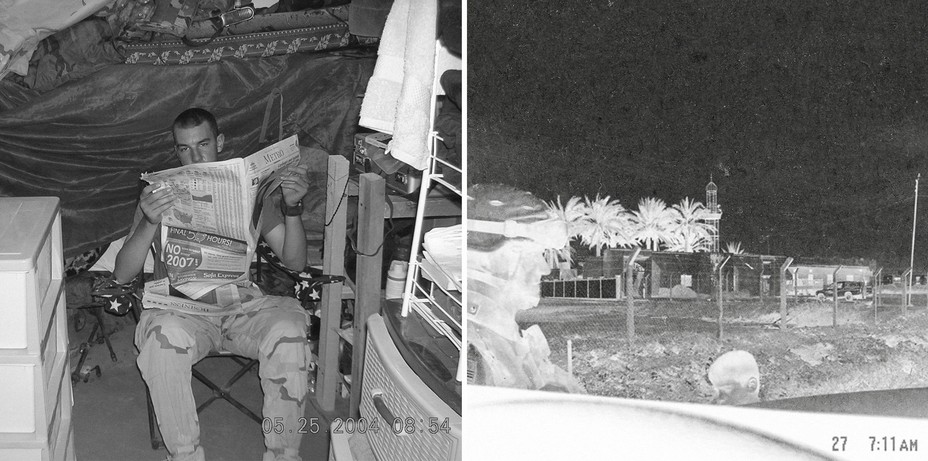
In 2004, five months into my unit's deployment to Iraq, I woke upwards subsequently a night of patrols. I made java, sat on my cot, and began to read from the stacks of newspapers that my mother would send once a month. Copies of the Cleveland Manifestly Dealer, e'er a few weeks quondam. Reading the sports pages and local news from abode normally made me feel calm, grounded. I also had a routine to look, when I could, at the U.S. Department of Defense prey list. I couldn't help just check information technology. I scanned the list, as I had hundreds of times. Seemingly out of nowhere, I saw Nick's name. I couldn't believe information technology. I looked at the name once again. In my mind, he was still at Knox, where I'd seen him a year and a one-half before. I idea of how he'd promised to show me around Columbus. Sitting there, in 2004, I thought this was still a possibility. I felt like I wanted to rip up the paper, just I simply stared at it.
I call up thinking, for a second, that this name in the paper was spelled differently than the 1 I'd imagined. "Nicholaus." That couldn't be him. But how could I have known, in basic, how to spell his commencement name? Of course it was him. It was in the paper. It'south on the sign.
In 1912, arguing earlier the House of Representatives, William P. Borland said, "Now, the question will be raised … as to the appropriateness of a highway as a memorial every bit compared with what is regarded as the conventional form of a memorial building, or something utterly useless." Borland wanted to construct a memorial highway for Abraham Lincoln from the city of Washington to Gettysburg, Pennsylvania. The "utterly useless" building he referred to was the Lincoln Memorial, which would be built and dedicated on the National Mall in 1922. Borland, like many people at the time and many today, argued for utilitarianism over aesthetics. "The nearer a memorial comes," he said, "to beingness actually useful to the people now living upon the Earth the better it is, non merely every bit a memorial, merely as an expenditure of the taxpayers' money." For Borland and others, useful implied that a memorial should align with some public service or good, similar a highway from D.C. to Gettysburg, a distance that, in 1912, took most a day to travel due to poor roadways. His proposal was rejected, just equally the century went on, and as highways and roadways multiplied, and so did naming and making them into memorials.
Although pinpointing the commencement military-related memorial highway is difficult, the confluence of American roadways and armed forces-themed memorials goes back at least to 1945, when the New Bailiwick of jersey State Quango of Garden Clubs dedicated a 5-and-a-half-mile section of U.South. 22. Called the Blue Star Memorial Highway—after the banner hung on homes for a serving family member—this highway honored New Jersey citizens who'd served during World War II. Consisting of more than 6,000 flowering dogwood trees planted along the road, this "living memorial," the New Bailiwick of jersey State Quango of National Garden Clubs explained, "would be meliorate to help adorn and preserve the country the men had fought for than to build rock monuments." I of the other benefits was the sheer volume of vehicles that would pass by the memorial: "Every bit this 4-lane highway is ane of the great traffic arteries betwixt New Jersey and other states, it is estimated that 29,000 cars will pass the memorial daily." As Blueish Star Memorial Highways spread across the country, names of specific soldiers, many of them Medal of Honor recipients, began to appear as well. Since nine/eleven, highway memorial signs for veterans have multiplied in nearly every country, specially Ohio. Remembrance, if that'south the best give-and-take, could accept identify on a massive, collective scale—a abiding bulldoze-by of celebration.
One tin can't assistance but note another parallel to this ascent of drive-by memorials: the 1930s invention of the bulldoze-through, outset at banks and then at restaurants. Like shooting fish in a barrel and convenient, the drive-through saves united states time and gets us back on the route.
I doubtable that Nick'due south sign, for most drivers, constructs a simple narrative—a soldier dies; he is memorialized on a highway; we remind ourselves of said soldier as we pass.
The sign, similar any memorial, contributes to the structure of American identity.
The sign implicitly praises militarism, nationalism, and coating reverence for the American dead, no thing the efficacy of the war.
The sign means to remind drivers—or impose upon them—on the mode to work or a football game or the mall, that nosotros Americans value our war expressionless.
The sign hopes to strengthen the social fabric between self and nation.
The sign, if I want to defend it, does push, perhaps in a productive way, Nick'southward ghost into the present.
Does the sign fight complacency, albeit weakly, by informing countless individuals passing in their vehicles of one more expressionless veteran's name?
Does the sign, juxtaposed against corporate logos for hotels and fast nutrient and gasoline, diminish or ironize Nick?
Does the sign but say, Here, think nearly the war, briefly—but keep your optics on the road?
One reason Borland wanted a memorial for Lincoln outside of D.C. involved an experience he had had during his start congressional term, in 1909. In a story about walking around the city with a friend, Borland described how they "passed monument after monument to expressionless men, some of them men whose names and services nosotros could not remember." Borland later ended, "There is a limit to the extent that nosotros can beautify the city of Washington by mere monuments and memorials to dead men, many of them expressionless memorials to dead men."
In his 1995 article "The Monument Glut," James Reston Jr. argues that the proliferation of state of war memorials in Washington, D.C., makes visiting the National Mall "the walking-around equivalent of changing channels on a television." The need to produce and construct "memorials," fifty-fifty on highways juxtaposed against fast-food signs in fields behind UPS-shipping warehouses—where Nick's sign stands—seems, if annihilation, a bit desperate.
In some states, such as Florida, roadside memorial signs are and so prevalent that they're viewed as "clutter." From 1998 to 2011 alone, the Florida Department of Transportation erected 738 signs. U.Due south. Route nineteen in Florida, a 160-mile stretch betwixt Crystal River and Tallahassee, hosts dozens of memorial signs. Among its many names are the Blue Star Memorial Highway, the Nature Coast Trail, and the names of dead American soldiers, police officers, and politicians. In a 2011 article in the St. Petersburg Times (now the Tampa Bay Times), then–Democratic State Senator Larcenia Bullard said, "Nosotros're cluttering the highways with all these signs." Former Republican State Senator Greg Evers expressed disappointment that a roadside memorial sign for Air Force Colonel George "Bud" Day, a Medal of Honor recipient, had to be shared with other road memorials. "To honor a person of that caliber, information technology shouldn't just exist a memorial," Evers said. "He should deserve the full dedication of the route."
Only how much route is enough?
Years before seeing Nick's sign I read near the nonprofit Ohio Flags of Award, which was started by Nick'due south parents. Until this twelvemonth, they traveled around Ohio and displayed American flags in parks and other public spaces. Each flag was inscribed with the name of an Ohio soldier who had been killed overseas since nine/11. The exhibit required yous to move among the 302 flags. Like visitors to Maya Lin's Vietnam Veterans Memorial in Washington, D.C., individuals had to explore and search equally they read the names inscribed on the poles. The process involved endeavor and participation. I idea of some other parent, Carlos Arredondo, whose 20-twelvemonth-old son was also killed in Iraq in 2004. Over time Arredondo created a mobile memorial that he takes to parades, ceremonies, and demonstrations. Although information technology includes his son's uniform, boots, dog tags, and medals, the nearly stark chemical element involves a flag-draped wooden coffin, which Arredondo wheels effectually on a cart. "I think people need to see that," Arredondo told Linda Pershing, an associate professor at California State Academy at San Marcos. "If they don't see information technology, they don't feel it. If they don't feel information technology, they don't care."
In the months after I returned from Iraq in 2005, I learned to be cautious when mentioning the war. Sometimes it could silence an entire room and I'd find myself stared at every bit if I'd announced that I was dying. Other times people would express their cheers and mention some afar link to the war—their cousin's boyfriend or a neighbor's son had besides served and, therefore, they sympathized with any experience they imagined I had had.
What'due south easier than talking, of class, is to just install a $500 freeway sign.
The 133rd Ohio General Assembly, which met during 2019–20, introduced legislation to add more than 60 new highway memorial signs to the existing tally of 394. The 134th Ohio General Assembly, which adjourns on the last day of 2022, has introduced legislation for at least 39 more highway memorial signs.
After Nick'due south sign was installed, in a 2014 article almost its dedication and placement, Ohio Representative Cheryl Grossman said, "This is very important … Let us never forget." But with a similar memorial sign every few miles or so, how could we call back?
This article originally misstated the name of Crystal River, Florida.

American War Chapter 1 Summary,
Source: https://www.theatlantic.com/politics/archive/2021/12/memorial-highway-signs-soldiers-meaning/621011/
Posted by: lyonsupor1988.blogspot.com
0 Response to "American War Chapter 1 Summary"
Post a Comment